Nicomachean Ethics
About This Book
What It's About
The Nicomachean Ethics is Aristotle's most influential work on moral philosophy, and one of the founding texts of Western ethics. In it, he asks what the highest good for human beings is, and argues that it is eudaimonia — often translated as "happiness" or "flourishing" — achieved not through pleasure or wealth, but through a lifetime of virtuous activity guided by reason. The work examines how virtue is formed through habit, how moral choice works, and what role friendship, pleasure, and contemplation play in a well-lived life. Traditionally thought to be named after Aristotle's son Nicomachus, who may have edited the work after his father's death.
Key Concepts
Central to the work is the idea of virtue as a mean between two extremes of excess and deficiency — courage, for instance, sitting between recklessness and cowardice. Aristotle distinguishes moral virtues (developed through habit and practice) from intellectual virtues (developed through teaching), and gives particular importance to practical wisdom (phronesis), the capacity to judge rightly in specific situations. The book also devotes substantial attention to friendship, treating it as essential to a flourishing life, and closes by arguing that a life of contemplation is the highest form of human happiness.
About the Author
Aristotle (384–322 BC) was an ancient Greek philosopher and polymath. Born in Stagira, he studied under Plato at the Academy in Athens before later founding his own school, the Lyceum. He also served for a time as tutor to the young Alexander the Great. His writings covered an extraordinary range of subjects, from logic and metaphysics to biology and politics, and shaped the course of Western philosophy for centuries after his death.
About This Edition
This is a 1908 translation by W. D. Ross.
At a glance
- Full title
- Nicomachean Ethics
- Alternative title
- Ēthika Nikomacheia
- Author
- Aristotle (384–322 BC)
- Translated by
- W. D. Ross (1908)
- Subject
- Ethics, Moral Philosophy
- Key concepts
- Virtue, Eudaimonia, The Golden Mean, Practical Wisdom
- Available formats
- PDF, EPUB, AZW3 (Kindle), Read Online — all free
- Copyright status
- Public domain
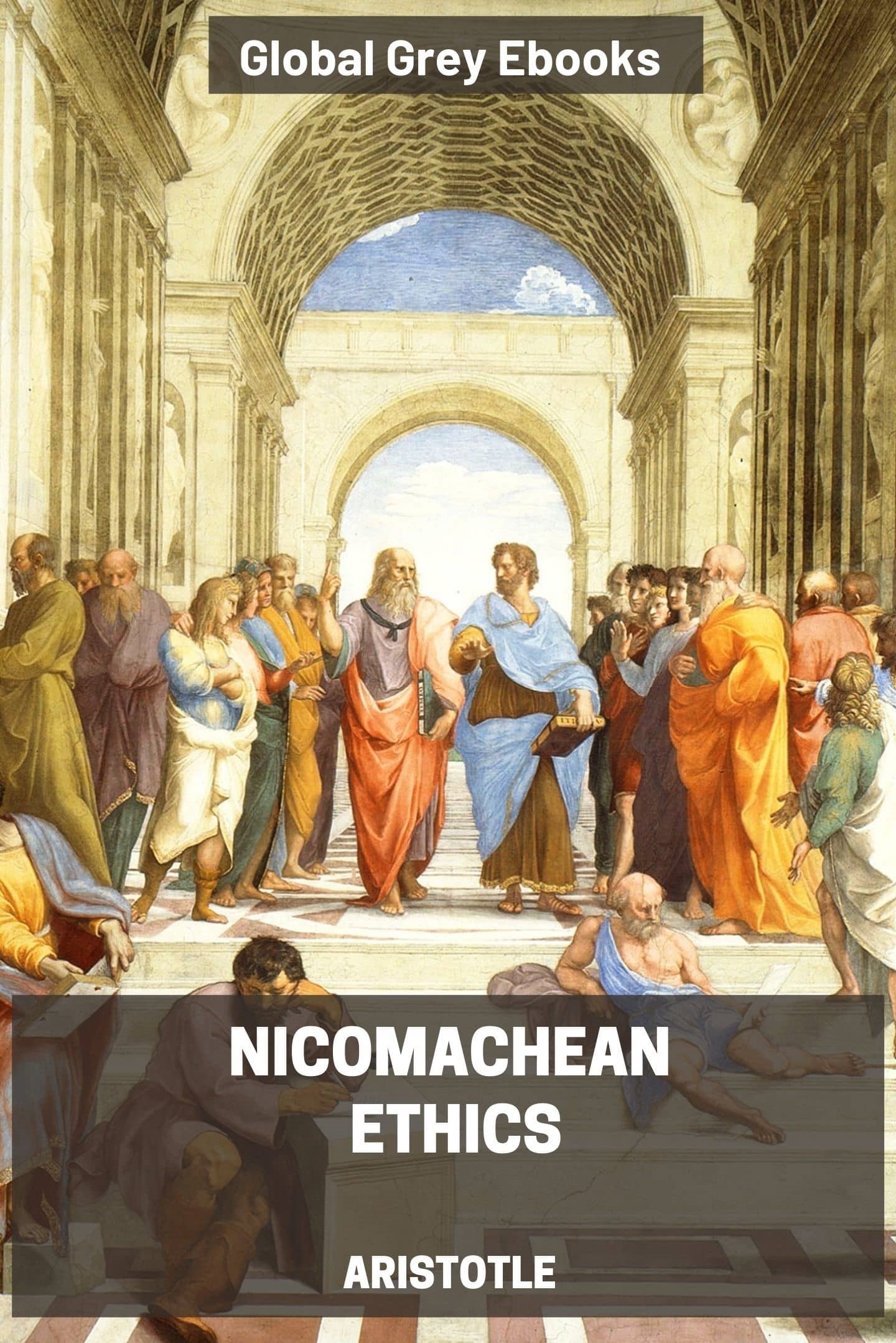
- Cover Artwork
- Raphael - The School of Athens
This edition is provided free of charge with no registration required. If you find it useful, please consider supporting Global Grey.
Related Ebooks