The Cabala
About This Book
What It's About
A short, scholarly history of the Cabala, the system of Jewish mysticism that shaped Jewish and Christian thought from the Middle Ages onward. The author traces its roots in early visions of God's throne and the mysteries of Creation, follows its growth through works such as the Book of Creation, and gives a chapter to the Zohar, its central text. He then covers the later Cabalists, including Isaac Luria, the false messiah Sabbatai Zevi and the Chasidim, before setting out the main doctrines. The final chapter weighs the Cabala's effect on Judaism and its long fascination for Christian thinkers such as Pico della Mirandola and Reuchlin. Written from a Christian, Protestant scholarly standpoint, it is openly critical of its subject and often dismissive of it. It leans heavily on German scholarship, especially Franz Delitzsch's student Wünsche and the Zohar researches of Adolf Jellinek. Modern scholars would take a more sympathetic view of the Cabala as a genuinely Jewish tradition, but the book is still a useful record of how the subject was understood at the start of the twentieth century.
Key Concepts
The Zohar, the "Book of Splendor", is the Cabala's central text. Tradition ascribes it to the second-century sage Simon ben Jochai, but the book argues that Moses de Leon wrote it in thirteenth-century Spain. The Cabalists call God the En Soph, "the Boundless", who reveals himself through ten emanations known as the Sephiroth, pictured as the Archetypal Man (Adam Kadmon) and as a cosmic tree. Other teachings covered include four descending worlds, the pre-existence and transmigration of souls, a realm of evil opposed to the realm of light, and the Messiah's role in restoring harmony. The book also describes the Cabalists' methods for finding hidden meanings in Scripture: gematria (numerical values of letters), notarikon (reading words as abbreviations) and temurah (letter substitution).
About the Author
Bernhard Pick (1842–1917) was a German-born American Lutheran pastor and scholar. Born in Kempen, Prussia, he studied at Breslau, Berlin and Union Theological Seminary in New York, and went on to serve congregations in New York and Pennsylvania. He was known for his learning in Jewish literature and early Christian history.
At a glance
- Full title
- The Cabala
- Alternative title
- The Cabala: Its Influence on Judaism and Christianity
- Author
- Bernhard Pick (1842–1917)
- First published
- 1913
- Subject
- Jewish mysticism and its influence on Judaism and Christianity
- Key concepts
- The Zohar, En Soph and the Sephiroth, Adam Kadmon, gematria, transmigration of souls
- Available formats
- PDF, EPUB, AZW3 (Kindle), Read Online — all free
- Copyright status
- Public domain
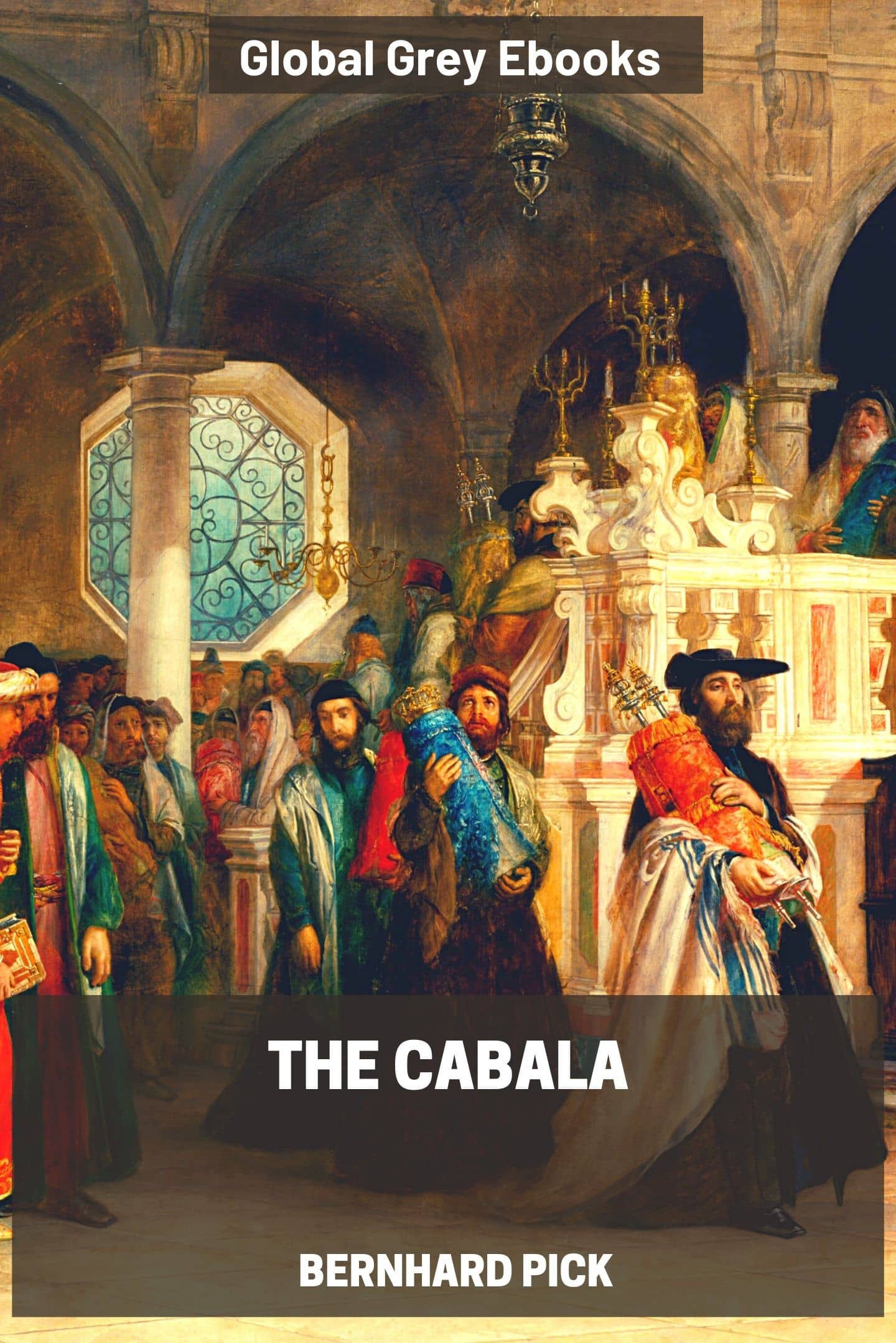
- Cover Artwork
- Solomon Hart - The Feast of the Rejoicing of the Law
This edition is provided free of charge with no registration required. If you find it useful, please consider supporting Global Grey.
Related Ebooks